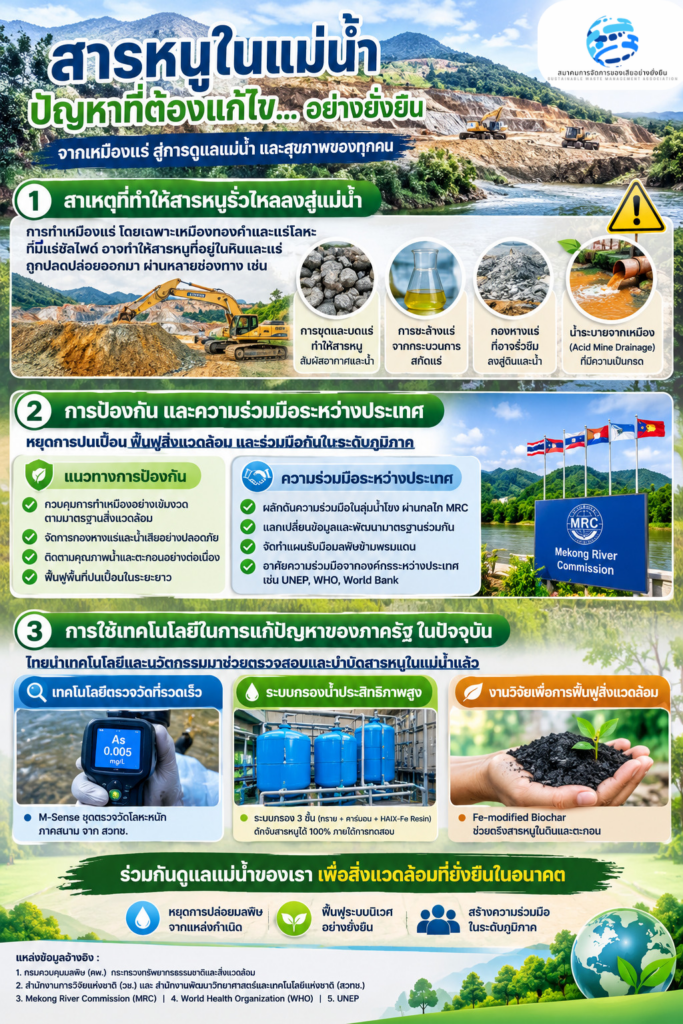
Arsenic contamination in water sources is an environmental issue that affects ecosystems, water quality, and public health. This is particularly concerning in areas near mining operations, where contamination can occur during mineral extraction and mine tailings management if proper environmental controls are not in place.
🔎 1. Causes of Arsenic Contamination in Rivers
Mining activities, particularly gold and metal mining involving sulfide minerals, can release naturally occurring arsenic from rocks and minerals into the environment through several pathways, including:
▪️ Mineral excavation and crushing: Expose arsenic-containing minerals to air and water.
▪️ Mineral washing processes: May release arsenic into wastewater.
▪️ Mine tailings: Improperly managed tailings storage facilities may allow contaminants to seep into soil and water sources.
▪️ Acid Mine Drainage (AMD): Acidic drainage from mining sites can transport arsenic and other contaminants into nearby water bodies.
🛡️ 2. Prevention and International Cooperation
Addressing this challenge requires both pollution prevention at the source and international cooperation. Key approaches include:
▪️ Enforcing strict environmental standards for mining operations.
▪️ Ensuring the safe management of mine tailings and wastewater.
▪️ Continuously monitoring water and sediment quality.
▪️ Conducting long-term rehabilitation of contaminated areas.
▪️ Strengthening cooperation across the Mekong River Basin through mechanisms such as the Mekong River Commission (MRC), including information sharing, the development of common standards, and coordinated responses to transboundary pollution.
🤖 3. Government Use of Technology to Address the Problem
Technology and innovation play an important role in monitoring and treating arsenic contamination in the environment. Key examples include:
▪️ M-Sense: A field-based heavy metal testing kit that enables rapid monitoring of water quality.
▪️ High-Efficiency Water Filtration System: Uses a three-layer filtration system consisting of sand, activated carbon, and HAIX-Fe Resin to capture arsenic.
▪️ Fe-modified Biochar: An innovative bio-based material that helps immobilize arsenic in soil and sediment, supporting the rehabilitation of contaminated areas.
🌱 Working Together to Protect Our Rivers for a Sustainable Future
Addressing arsenic contamination requires cooperation among all sectors, from controlling pollution at its source and continuously monitoring environmental quality to adopting innovative technologies and strengthening international collaboration. These efforts are essential to keeping our rivers clean, restoring ecosystems, and ensuring that communities have access to safe water.
#ArsenicContamination #PollutionManagement #Mining #InternationalCooperation #EnvironmentalSustainability #SWMA